
Lightning
The Rambam's experience

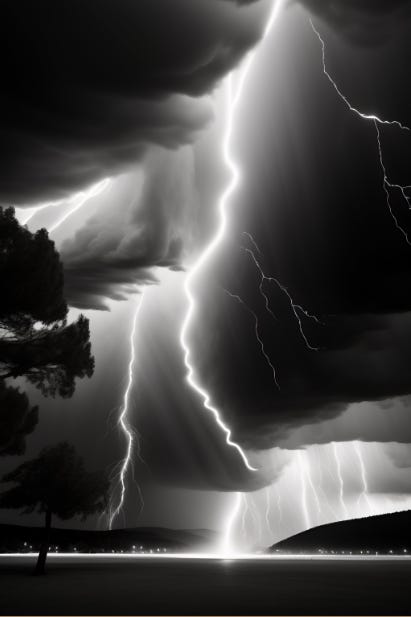
The Rambam, possibly more than anyone else in history, tackles the impossible task of describing what it is like to experience the non-physical, which, as we have been clear, is a specific experience known exclusively to those who have put in the work. As we’ll see, this experience is the first step in understanding higher Judaism (or any ancient religion for that matter).
We will begin learning some parts of the Rambam’s Guide carefully, to give over a picture of what the Rambam was really about. We will try to give over ‘sound-bytes’ at a time; but at the same time if you can’t have the patience to read and apply yourself just a little, you will get truly nowhere. Without further ado, let’s begin.
The Rambam writes in his introduction:
ולא תחשב שה׳סודות׳ העצומות ההם ידועות עד תכליתם ואחריתם לאחד ממנו. לא כן אבל פעם יוצץ לנו האמת עד שנחשבנו יום; ואחר כן יעלימוהו הטבעים והמנהגים עד שנשוב בליל חשך קרוב למה שהיינו תחלה ונהיה כמי שיברק עליו הברק פעם אחר פעם – והוא בליל חזק החשך:
Do not imagine that these most difficult problems can be thoroughly understood by any one of us. This is not the case. At times the truth shines so brilliantly that we perceive it as clear as day. Our nature and habit then draw a veil over our perception, and we return to a darkness almost as dense as before. We are like those who, though beholding frequent flashes of lightning, still find themselves in the thickest darkness of the night.
והנה יש ממנו מי שיברק לו הברק פעם אחר פעם במעט הפרש ביניהם עד כאלו הוא באור תדיר לא יסור וישוב הלילה אצלו כיום; וזאת היא מדרגת גדל הנביאים אשר נאמר לו ״ואתה פה עמד עמדי״ ונאמר בו ״כי קרן עור פניו וכו׳״. ויש מי שיהיה לו בין ברק לברק הפרש רב – והיא מדרגת רב הנביאים. ומהם מי שיברק לו פעם אחת בלילו כלו – והיא מדרגת מי שנאמר בהם ״ויתנבאו ולא יספו״. ומהם מי שיהיה בין בריקה לבריקה הפרשים רבים או מעטים:
On some the lightning flashes in rapid succession, and they seem to be in continuous light, and their night is as clear as the day. This was the degree of prophetic excellence attained by (Moses) the greatest of prophets, to whom God said, “But as for thee, stand thou here by Me” (Deut. 5:31), and of whom it is written “the skin of his face shone,” etc. (Exod. 34:29). [Some perceive the prophetic flash at long intervals; this is the degree of most prophets.] By others only once during the whole night is a flash of lightning perceived. This is the case with those of whom we are informed, “They prophesied, and did not prophesy again” (Num. 11:25). There are some to whom the flashes of lightning appear with varying intervals;
ויש מי שלא יגיע למדרגה שיאור חשכו בברק אבל בגשם טהור זך או כיוצא בו מן האבנים וזולתם אשר יאירו במחשכי הלילה. ואפילו האור ההוא הקטן אשר יזרח עלינו גם כן אינו תדיר אבל יציץ ויעלם כאלו הוא ׳להט החרב המתהפכת׳.
others are in the condition of men, whose darkness is illumined not by lightning, but by some kind of crystal or similar stone, or other substances that possess the property of shining during the night; and to them even this small amount of light is not continuous, but now it shines and now it vanishes, as if it were “the flame of the rotating sword.”
וכפי אלו הענינים יתחלפו מדרגות השלמים. אמנם אשר לא ראו אור כלל אפילו יום אחד אבל הם בלילה יגששו – והם אשר נאמר בהם ״לא ידעו ולא יבינו בחשכה יתהלכו״ – ונעלם מהם האמת כלו עם חזק הראותו כמו שאמר בהם ״ועתה לא ראו אור בהיר הוא בשחקים״ והם המון העם – אין מבוא לזכרם הנה בזה המאמר:
The degrees in the perfection of men vary according to these distinctions. Concerning those who never beheld the light even for one day, but walk in continual darkness, it is written, “They know not, neither will they understand; they walk on in darkness” (Ps. 82:5). Truth, in spite of all its powerful manifestations, is completely withheld from them, and the following words of Scripture may be applied to them, “And now men see not the light which is bright in the skies” (Job 37:21). They are the multitude of ordinary men: there is no need to notice them in this treatise.
If you read my post, “Angels?” well, you will see what the Rambam is describing a little bit. Our physicality blinds us from this other reality, so even when we do experience it, it is just a flash. But let’s make no mistake: despite it’s elusive nature, the Rambam describes that the ‘flash’ can be as clear as day. He chooses the example of lightening precisely because that experience is also only a flash, but it is as real as the light of the sun. The fact that it is short and that the bodily senses then pull the person back shortly after, makes it no less real.
The Rambam was obviously not talking about actual lightening. There are no lights which turn on, no images popping out of the sky. No hallucinations. But, we must note again that anyone who knows what the Rambam means, knows what he means. But anyone who doesn’t, “Truth, in spite of all its powerful manifestations, is completely withheld from them,” says the author זצ”ל quite clearly, and “there is no need to notice them in this treatise.” The truth the Rambam is discussing, which is for those who have beholden it, is the foundation of the entire Moreh. Without it the Moreh is rendered largely meaningless, and the Rambam would rather those “fools” stayed away.
The Rambam, when discussing these lofty ideas, was very unkind to the masses. Most people, he acknowledges, have no conception. Those who have a conception are part of this elite club which requires tremendous effort to enter, as he explains later. But these kinds of people are the people who actually understand Judaism, and also can understand Aristotilien philosophy, and these are the people that the Rambam is reaching out to.
The question will become, how do we explain these ideas to those who don’t understand them? Interestingly, even to those who do understand them, the words we need to use to talk about them need to be definite and physical, because language itself only describes experiences. These lightening experiences also are understood only in context of the non-physical. So we need to use the concepts of משל: parables, allegories, metaphors, and the concepts are then incorporated into the non-physical lexicon as real as the experience itself.
For this very reason, much of the Rambam’s Moreh (the major bulk of part I is almost exclusively about removing “הגשמה,” corporeality, from God. He goes to explain the physical metaphors given for the non-physical concepts. Such as God sitting, moving, getting angry, talking, and so on, because these physical words have meaning in the non-physical world as well. As he explains in his introduction, his goal was to allow a reader to experience the conception of non-physicality, which is done by focusing on that realm, by leaving this world of materialism and thinking about the “spiritual” side.
By getting involved in the world of the non-physical, the removal of הגשמה, one can perhaps experience a small flash here and there, and the Rambam wrote it in a way that these flashes be inspired.
The first time I heard the lightning metaphor (I think it was on a YouTube channel called "Seekers of Unity"), lots of things clicked for me; even though I knew the story of Plato's Cave from my philosophy class, I didn't really understand it until I heard the lightning metaphor because we get moments, fleeting moments where everything is connected and it seems like we can change the world by only changing ourselves, but it's so much harder to get to that point of true ecstasy than it is for that feeling to leave you.